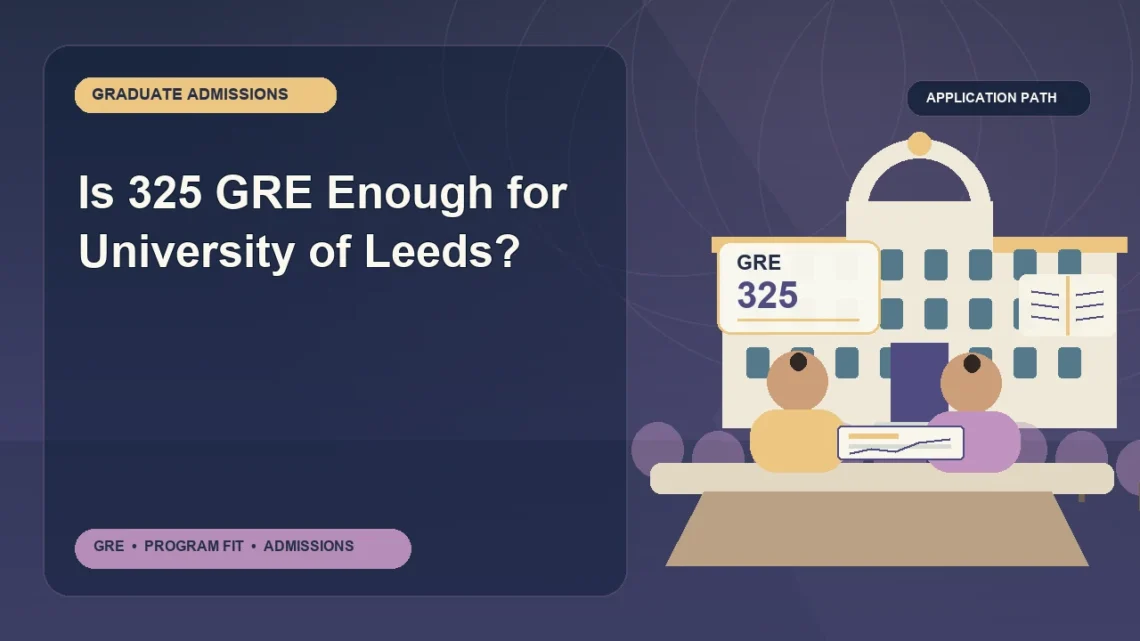
Yes, a 325 GRE score is generally strong for the University of Leeds, but whether it is “enough” depends on the specific program, your academic background, and whether the department still considers GRE scores in its admissions review.
The University of Leeds is a major research university, and admissions decisions are usually made at the program level rather than by a single university-wide GRE standard. In practice, a 325 can be a competitive score for many graduate applicants, especially if your GPA, transcripts, statement of purpose, references, and relevant experience are strong. However, some programs do not require the GRE at all, and others may place far more weight on subject preparation, prior degrees, or research fit than on test scores.
If you are applying to Leeds, the most important question is not only whether 325 is a good GRE score in general, but whether your target department asks for the GRE and how it uses it. For many applicants, the score is more than adequate. For others, it may not matter because the GRE is not considered.
Program and admissions overview
The University of Leeds is known for a broad range of master’s and doctoral programs across subjects such as business, engineering, social sciences, law, life sciences, and the humanities. Because graduate admissions are handled by individual schools and departments, requirements can vary significantly from one program to another.
That means the answer to “Is 325 GRE enough for University of Leeds?” depends on several factors:
- The specific degree you are applying to, such as MSc, MA, MRes, MBA, or PhD
- The department’s admissions policy, including whether the GRE is required, optional, or not considered
- Your previous academic record, including degree classification or GPA equivalent
- Your subject background and whether it matches the program
- Your research experience for research degrees
- Your English language proficiency, if applicable
For many applicants, Leeds uses a holistic admissions process. That means the admissions team reviews the whole application rather than relying on one test score alone. A strong GRE score can support your case, but it does not guarantee admission, and a lower score may not automatically disqualify you if the rest of your application is compelling.
Current GRE policy
The University of Leeds does not publish a single university-wide GRE policy that applies to all graduate programs. GRE expectations, if any, are usually set by the individual school, department, or program.
In practical terms, this means the GRE may fall into one of several categories depending on the course:
- Required for some programs
- Recommended for certain applicants or backgrounds
- Optional in programs that may consider it but do not require it
- Not considered in many UK graduate admissions processes
If a Leeds program page does not mention the GRE, do not assume it is required. In the UK, many universities focus more heavily on prior degree results, academic references, and subject fit than on standardized tests. For that reason, you should always check the official program page and, if needed, contact the department directly.
Bottom line: a 325 GRE score may be strong, but for many University of Leeds programs, the more important question is whether the GRE is used at all.
How strong is a 325 GRE score for Leeds?
A 325 on the GRE is widely considered a strong result. In general GRE terms, it suggests solid performance across the verbal reasoning and quantitative reasoning sections. For many graduate programs, a 325 would usually be viewed favorably if the score is part of the review process.
That said, “enough” depends on context:
- If the GRE is required: 325 is likely a competitive score for many programs, though some highly selective or quant-heavy programs may expect even stronger section balance.
- If the GRE is optional: a 325 can help reinforce your application, especially if your GPA or background is less conventional.
- If the GRE is not considered: the score may not affect your admissions outcome at all.
It is also important to look beyond the total score. Many departments care about the section breakdown. For example:
- Quantitative-heavy programs may care more about the quantitative score
- Humanities and social science programs may value verbal reasoning more
- Research-focused programs may care more about subject preparation and writing ability than the GRE total
If your 325 includes a strong balance between verbal and quantitative scores, that can be especially useful. If one section is much weaker than the other, the overall impact depends on the discipline.
Academic requirements at the University of Leeds
Because the University of Leeds evaluates applicants by program, academic requirements vary. In most cases, admissions teams look closely at the following:
Prior degree level and subject fit
Most taught master’s programs expect applicants to hold a relevant bachelor’s degree or its equivalent. For research degrees, such as PhD or MPhil, Leeds typically expects a strong academic record and preparation for independent research.
Subject alignment is particularly important. If your previous degree is in a different field from the one you want to study at Leeds, the department may ask for evidence that you can succeed academically in the new area. A strong GRE score can sometimes support that case, but it is rarely the deciding factor on its own.
Academic performance
Leeds generally looks for strong prior grades. The exact academic standard depends on the program, and the university does not publish a single GRE-to-GPA conversion. If your academic record is borderline for the course, a 325 GRE score may strengthen your profile, but it will not automatically overcome weak preparation in the relevant subject.
References and supporting documents
Most graduate programs require academic references and a personal statement or similar supporting statement. For research degrees, a proposal or evidence of research interests may also be important. These materials help the department judge whether your background matches the program’s expectations.
English language proficiency
If English is not your first language, Leeds typically requires proof of English proficiency through an accepted test such as IELTS or TOEFL, depending on the program’s published requirements. The exact requirement varies by course, so applicants should verify the current standard on the official program page.
Program-specific expectations that matter more than the GRE
At the University of Leeds, program-specific factors often matter more than one test score. This is especially true for master’s and doctoral applicants. Below are some of the most important areas to consider.
Business and management programs
For business-related graduate study, departments often evaluate quantitative readiness, career goals, and professional experience. Some business programs may consider standardized tests, while others emphasize academic transcripts and work experience. If a business program at Leeds asks for the GRE, a 325 is usually a respectable score, but the department may still look closely at your quantitative section and prior coursework in math, economics, statistics, or analytics.
Engineering and science programs
In technical fields, the admissions team often cares most about your previous study in the discipline, grades in relevant courses, and research potential. A strong quantitative GRE score can help, but a 325 total score is only part of the picture. For applicants from nontraditional backgrounds, the university may want clear evidence that you can handle the technical demands of the program.
Social sciences and policy-related programs
Programs in economics, politics, sociology, education, and public policy may place different weight on verbal reasoning, quantitative reasoning, and academic writing. A 325 can be strong, but the department may focus more on your transcript, writing sample, and fit with the program’s curriculum or research areas.
Humanities programs
For humanities programs, the GRE is often less central than academic writing ability, prior subject study, and research interests. If the GRE is required, a 325 would generally be a positive result, especially if verbal reasoning is strong. However, applicants should not assume the score will outweigh the importance of subject specialization and a persuasive academic statement.
Research degrees
For PhD and research master’s applicants, Leeds may place the greatest emphasis on:
- Your prior research training
- The quality of your research proposal, if required
- Your fit with faculty expertise
- Your academic record in relevant subjects
- Your ability to complete an independent project
For these applicants, a 325 GRE score can support an application, but faculty alignment and research preparation usually matter more.
Competitiveness and applicant profile
The University of Leeds is a well-regarded research university, and many of its graduate programs are competitive or selective. However, competitiveness varies widely by school and course.
Here is a practical way to think about a 325 GRE score in the Leeds context:
| Admissions context | How a 325 GRE is usually viewed |
|---|---|
| GRE required and used in review | Strong and competitive for many programs |
| GRE optional | Helpful signal of academic readiness |
| GRE not considered | Possibly irrelevant to the decision |
| Highly quantitative or highly selective program | Potentially strong, but not sufficient alone |
A 325 is most useful when it complements the rest of your profile. Applicants who are usually strongest for Leeds tend to have some combination of the following:
- A relevant academic background
- Strong grades in subject-related courses
- Clear reasons for choosing the specific Leeds program
- Evidence of readiness for graduate-level study
- For research degrees, a good match with faculty interests
On the other hand, a strong GRE score may not be enough if the application shows weak subject preparation, poor academic fit, or an unclear purpose for graduate study.
International applicant considerations
International applicants should pay special attention to requirements beyond the GRE. At the University of Leeds, these commonly include English language ability and documentation of prior qualifications.
English proficiency
If you are applying from a non-English-medium background, you may need to provide an accepted English test score. Leeds lists its requirements by program, so do not rely on general internet summaries. Check the official course page for the current standard.
Transcript and credential review
The university may evaluate international qualifications to determine whether they are equivalent to the UK degree level required for the program. If your transcripts are from a system that is unfamiliar to UK admissions staff, you may need to provide additional documentation or translations.
Funding and visa planning
If you receive an offer, international students typically need to prepare for visa documentation and proof of funding. These steps are separate from admissions, but they are essential to enrollment. Leeds and UK immigration rules can change, so applicants should review the official university guidance and government information carefully.
GRE scores for international applicants
For some international applicants, a GRE score of 325 can help demonstrate academic readiness, especially if the undergraduate grading system is difficult for admissions staff to compare directly. Still, the score is only one part of the file, and it does not replace transcript strength, English proficiency, or subject fit.
How to judge whether 325 is enough for your specific Leeds program
Use the following checklist to evaluate your chances realistically:
- Find the official program page. Check whether the GRE is required, optional, or not mentioned.
- Review the academic entry requirements. Look for subject prerequisites, degree classification expectations, and any special conditions.
- Compare your background to the course. Ask whether your previous study aligns with the program’s content.
- Check English language requirements. This is especially important for international students.
- Assess research fit, if applying for a PhD. Identify faculty whose work matches your interests.
- Consider your full profile. A 325 GRE score is strongest when the rest of the application is also solid.
If the program does not mention the GRE, you should not assume a 325 will help or hurt. In that case, your attention should shift to the published academic criteria and the quality of your supporting materials.
GRE policy summary for University of Leeds applicants
| Question | Practical answer |
|---|---|
| Is 325 a good GRE score? | Yes, it is generally a strong score. |
| Is 325 enough for University of Leeds? | Often yes if the program considers the GRE, but it depends on the department and your full profile. |
| Does Leeds have one GRE policy for all programs? | No. GRE policy can vary by department or program. |
| Will a 325 guarantee admission? | No. Admissions are based on the full application. |
| What matters most if the GRE is not required? | Academic record, subject fit, references, research preparation, and English proficiency. |
Frequently asked questions
Does the University of Leeds require the GRE?
Not universally. The University of Leeds does not publish one GRE rule for all graduate programs. Some departments may require or consider it, while many may not use it at all. Always check the specific course page.
Is 325 a competitive GRE score for Leeds PhD programs?
It can be competitive, but PhD admissions usually depend more on research fit, prior academic preparation, and faculty alignment than on the GRE alone. If the department does use the GRE, 325 is generally a strong result.
Is 325 enough for a master’s program at Leeds?
For many master’s applicants, yes, especially if the score is part of a broader strong application. But some Leeds programs do not consider the GRE, and others may prioritize degree results, subject prerequisites, or professional experience more heavily.
Does Leeds publish minimum GRE scores?
The university does not publicly publish a universal minimum GRE score. If a specific department has an internal preference or threshold, it should be checked on the official course page or confirmed directly with the admissions team.
Will a 325 compensate for a lower GPA?
It may help, but it usually cannot fully offset weak academic preparation. Admissions teams want evidence that you can handle the specific program, so subject grades and fit still matter a great deal.
Should international applicants submit GRE scores to Leeds?
Only if the program accepts or requests them, or if you believe the score adds value to your application. If the program does not use the GRE, focus instead on transcripts, English proficiency, and any required supporting documents.
Final thoughts
A 325 GRE score is generally strong for the University of Leeds, but the real answer depends on the program. If your target department uses the GRE, 325 will often be viewed positively. If the GRE is optional or not considered, the score may play little or no role in admissions.
For Leeds applicants, the most important steps are to confirm the department’s current GRE policy, review the academic entry requirements, and evaluate your overall fit with the course. In many cases, the best admissions strategy is not to ask whether 325 is enough in the abstract, but to ask whether your full profile matches the expectations of the specific program.
If you are applying to the University of Leeds, always verify the latest details on the official course page and with the department or graduate admissions office before submitting your application.