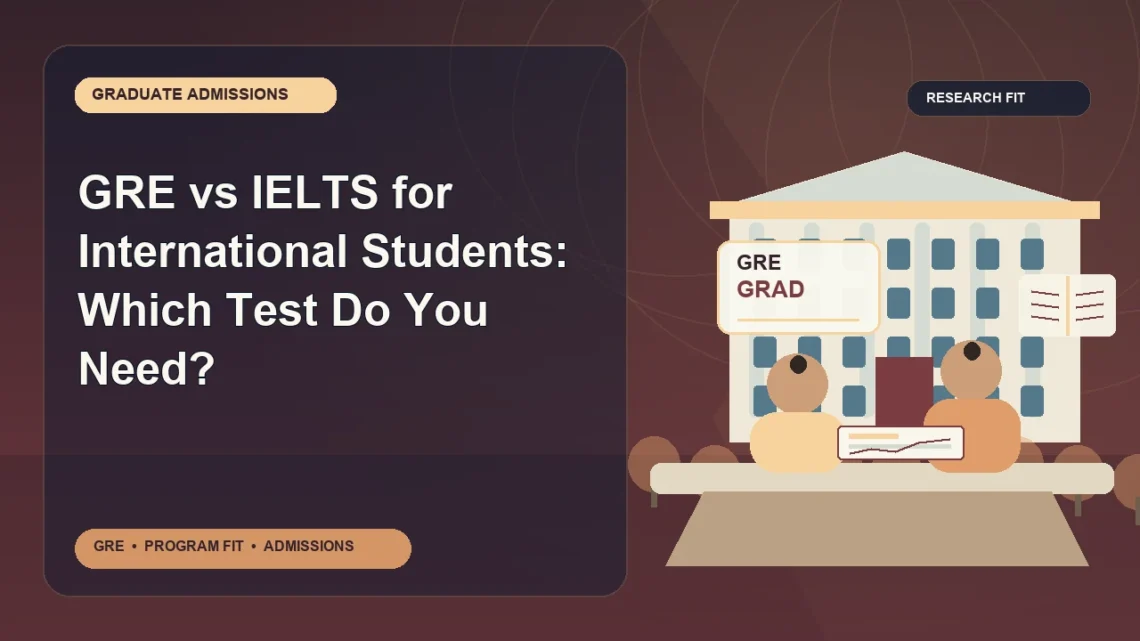
Choosing between the GRE and the IELTS is one of the first decisions international students face when preparing graduate applications. The two tests serve different purposes. The GRE measures readiness for graduate-level academic work across reasoning and math, while the IELTS measures English language proficiency. Which one you need depends on the programs and universities you apply to, and in many cases you will need both. This article explains what each test does, how admissions committees use scores, common application scenarios for international students, preparation tips, timing and cost considerations, and practical recommendations to help you decide which test or tests to take.
Quick answer: When to take the GRE, the IELTS, or both
GRE: Take the GRE General Test if your target graduate programs list it as an admissions requirement or recommendation. Typical programs that expect or prefer GRE scores include many PhD programs, STEM master’s programs, and some social science or humanities programs. Business master’s programs sometimes prefer GMAT but accept GRE scores.
IELTS: Take the IELTS Academic (or another approved English test such as TOEFL or PTE) if the university requires an English-proficiency proof and you do not qualify for an English-language waiver. The IELTS evaluates listening, reading, writing, and speaking in English for academic contexts.
Both: Many international applicants need both tests. For example, a student from a non-English-medium university applying to a U.S. STEM master’s program will often submit GRE scores for admissions and IELTS scores to meet English-proficiency requirements. Always check each program’s admissions page for precise requirements.
What each test measures and why that matters
GRE General Test: Purpose and skills assessed
The GRE General Test is intended to assess skills that are important for graduate-level study. It measures:
- Verbal Reasoning: reading comprehension, text completion, and sentence equivalence questions that test vocabulary, argument analysis, and critical reading.
- Quantitative Reasoning: basic arithmetic, algebra, geometry, and data interpretation that test quantitative problem solving and reasoning.
- Analytical Writing: two essays that evaluate your ability to present and support complex ideas clearly, organize arguments, and use standard written English.
Programs use GRE scores to compare applicants from diverse educational backgrounds on cognitive and analytical skills relevant to graduate study.
IELTS Academic: Purpose and skills assessed
The IELTS Academic test evaluates English language proficiency in four discrete skills:
- Listening
- Reading
- Writing
- Speaking
IELTS focuses on your ability to function in an English-speaking academic environment. Admissions offices use IELTS scores to confirm you can follow lectures, complete writing assignments, and participate in seminars.
Side-by-side comparison
| Feature | GRE General Test | IELTS Academic |
|---|---|---|
| Main purpose | Assess readiness for graduate-level academic work | Assess English language proficiency for academic study |
| Who typically requires it | Graduate programs in many disciplines, especially STEM, social sciences, and doctoral programs | Universities and programs that require proof of English proficiency for nonnative English applicants |
| Sections | Verbal Reasoning, Quantitative Reasoning, Analytical Writing | Listening, Reading, Writing, Speaking |
| Score format | Verbal 130–170, Quant 130–170, Writing 0.0–6.0 | Band score 0 to 9.0 overall and per skill |
| Typical use in admissions | Compare academic skills across applicants; often used with GPA, recommendations, and research experience | Verify ability to meet language demands of coursework and campus life |
| Delivery | Computer-delivered in test centers or at-home in some regions | Paper-based, computer-delivered, or in some places face-to-face for speaking |
| Validity | Typically valid for 5 years (confirm with ETS) | Typically valid for 2 years (confirm with test provider) |
How admissions committees use GRE and IELTS scores
Admissions committees use the two tests for different judgments:
- GRE: Helps committees judge academic potential relative to applicants from around the world. A strong GRE score can help offset lower GPA or unfamiliar grading systems, but committees rarely make decisions based on GRE alone. Committees weigh GRE scores alongside transcripts, letters of recommendation, research or work experience, and fit with the program.
- IELTS: Used to verify language readiness. Many programs set minimum band requirements by program level. Meeting the minimum is typically required to receive an offer or to enroll without additional language support. Some institutions also use IELTS subscore requirements, for example a minimum in the writing module.
Do you need both tests? Common scenarios for international students
Scenario 1: Applying to U.S. graduate programs (STEM, social sciences, humanities)
Many U.S. programs request GRE scores for admissions. If you were educated in a non-English-speaking country, the university may also require proof of English proficiency, typically IELTS Academic or TOEFL. Some universities will waive the language test if your prior degree was taught in English or if you meet other institution-specific criteria.
Scenario 2: Applying to UK, Australia, Canada, or other non-U.S. universities
In many countries outside the United States, English-proficiency tests like IELTS Academic are the standard requirement for international applicants. The GRE is less commonly required for coursework master’s programs in the UK and Australia. Research and doctoral programs may request the GRE in some disciplines or for particular universities. Always check the program’s admissions page.
Scenario 3: Applying to business programs
Many business master’s and MBA programs accept either GMAT or GRE. English-proficiency proof (IELTS or TOEFL) is still required for nonnative English applicants unless a waiver applies. Some business schools accept professional work experience or prior degree-in-English as partial evidence of language proficiency, but official policies vary.
Scenario 4: Strong English but weaker quantitative skills
If your target programs are quantitative and you are confident in English, the GRE is critical because strong quantitative scores are central to admissions decisions. If the program requires English proof and you already hold a degree taught in English, you may qualify for a waiver of IELTS, but check program policy.
Scenario 5: Strong quantitative skills but limited English proficiency
If your GRE quantitative score is competitive but your English skills need improvement, prioritize IELTS to satisfy language requirements. A low IELTS score can block admission even if your GRE is excellent.
How to decide which test to prioritize
- Check program pages first. Admissions pages list required tests. If a program requires both GRE and IELTS, plan to take both.
- Ask about waivers. Some programs waive IELTS if you have a degree taught in English or if you meet other criteria. These policies vary by country, university, and program.
- Match the test to the program’s evaluation focus. For technical, research-oriented programs the GRE is often more influential. For admission to programs where language use is critical, such as programs with heavy writing and seminar participation, the IELTS or other English tests matter more.
- Plan for deadlines and validity windows. If your IELTS result expires before matriculation, you may need to retake it even if you already submitted GRE scores. Factor test validity into scheduling.
Preparation: how study needs differ
GRE preparation
- Plan weeks to months of study depending on your baseline skills and target scores.
- Focus on quantitative fundamentals for STEM applicants, and on vocabulary, reading speed, and logical reasoning for verbal sections.
- Practice Analytical Writing with timed essays and get feedback to improve structure, clarity, and argumentation.
- Use official practice materials from ETS, timed practice tests, and targeted concept review.
IELTS preparation
- Work on the four skills in context. Practice note-taking from lectures and summarizing academic texts for Listening and Reading.
- Practice timed writing tasks with attention to task response, coherence, and grammatical range and accuracy.
- For Speaking, practice conversation on academic topics and record yourself to improve fluency and pronunciation.
- Take full-length practice tests under test conditions to understand timing and to build stamina.
Timing, scheduling, and score reporting
Plan tests with application deadlines in mind. Typical considerations include:
- Book tests early to get preferred dates and locations.
- Allow time for preparation, retakes if needed, and for official score reporting to arrive at institutions before deadlines.
- Understand result delivery timelines and validity periods. GRE and IELTS both have fixed validity windows, and delivery times can vary by test format and testing center.
- For the GRE, ETS offers score reporting to institutions. You can select score recipients at test time and send additional reports for a fee after the test. For IELTS, your official Test Report Form is typically sent to institutions on request; the test center can explain the procedure and fees.
Cost and validity considerations
Fees for both tests vary by country and test center. Expect to budget for test fees, preparation materials, potential coaching, and additional score reports if needed. Validity periods differ: IELTS scores are commonly valid for two years, and GRE scores are commonly valid for longer. Confirm validity and fee details with the test providers and the programs you plan to apply to.
Common misunderstandings and pitfalls
- “A high GRE score removes the need for IELTS.” Not usually true. GRE measures different skills than IELTS. Universities generally require proof of English proficiency separately unless they explicitly waive that requirement.
- “IELTS Academic proves academic readiness.” IELTS proves language ability. It does not replace GRE as evidence of analytical or quantitative skills that many graduate programs assess.
- “All programs accept either GRE or IELTS instead of the other.” Acceptance policies differ. Some programs never accept IELTS in place of GRE, and vice versa. Check each program.
- “One perfect test is enough.” Admissions decisions are holistic. Strong test scores help, but transcripts, letters of recommendation, statements of purpose, research or work experience, and fit with the program matter a great deal.
Practical recommendations and checklist
- Step 1: Read program requirements. Make a list of required tests for every program you plan to apply to.
- Step 2: Confirm English-waiver policies. If you believe you qualify for a waiver from IELTS, get written confirmation from the admissions office.
- Step 3: Map a schedule. Backwards-plan from application deadlines to choose test dates that allow time for prep and retakes if needed.
- Step 4: Target scores. Identify competitive score ranges for your field and program tier. Aim for scores at or above the typical range for admitted students.
- Step 5: Prepare strategically. Allocate study time according to your strengths and weaknesses. If English is a weaker area, allocate more time for IELTS preparation.
- Step 6: Documentation and score delivery. Understand how to send official scores to programs and when they will receive them.
Frequently asked questions
Can a high GRE verbal score replace the IELTS requirement?
Not usually. GRE and IELTS measure different constructs. Universities that require proof of English proficiency usually accept specific tests such as IELTS, TOEFL, or PTE. A strong GRE verbal score may strengthen your application, but it rarely substitutes for an official English-proficiency test unless the admissions office explicitly states a waiver is possible.
Will universities accept other English tests instead of IELTS?
Many universities accept multiple English-proficiency tests, including TOEFL, PTE, and sometimes institutional assessments. Check each program’s list of accepted tests. Some universities also accept alternative evidence such as completion of a degree taught in English from an accredited institution, but policies vary.
If my undergraduate degree was taught in English, do I still need IELTS?
Some programs waive the requirement for applicants who completed a degree taught in English at a recognized institution. Others still request an official English test result. Always request and document a waiver from the admissions office if you believe you qualify.
How should I prioritize study time if I need both tests?
Prioritize the test with the earliest deadline. If deadlines are similar, allocate study time according to your weaknesses. For example, split your weekly study hours with roughly two-thirds on your weaker test and one-third maintaining skills for the stronger test, adjusting as your practice performance improves.
Conclusion: make a choice that matches programs and your profile
The GRE and the IELTS serve distinct purposes. The GRE evaluates readiness for graduate academic work, while the IELTS evaluates English language proficiency. Many international students will need both, but exact requirements depend on the institutions and programs you choose. Start by checking each program’s admissions and English-waiver policies. Plan your schedule so you have time for thorough preparation and possible retakes, and set realistic target scores that align with the profiles of admitted students at your target programs. Verify deadlines, score validity, and reporting procedures directly with official test providers and the admissions offices you will apply to.
Further resources
- Official GRE information from ETS for format, scoring, fees, and registration details
- Official IELTS information for test formats, booking, and score reporting
- Program-specific admissions pages for English-proficiency and standardized-test policies
- GRE prep materials and IELTS practice tests from reputable providers for targeted practice