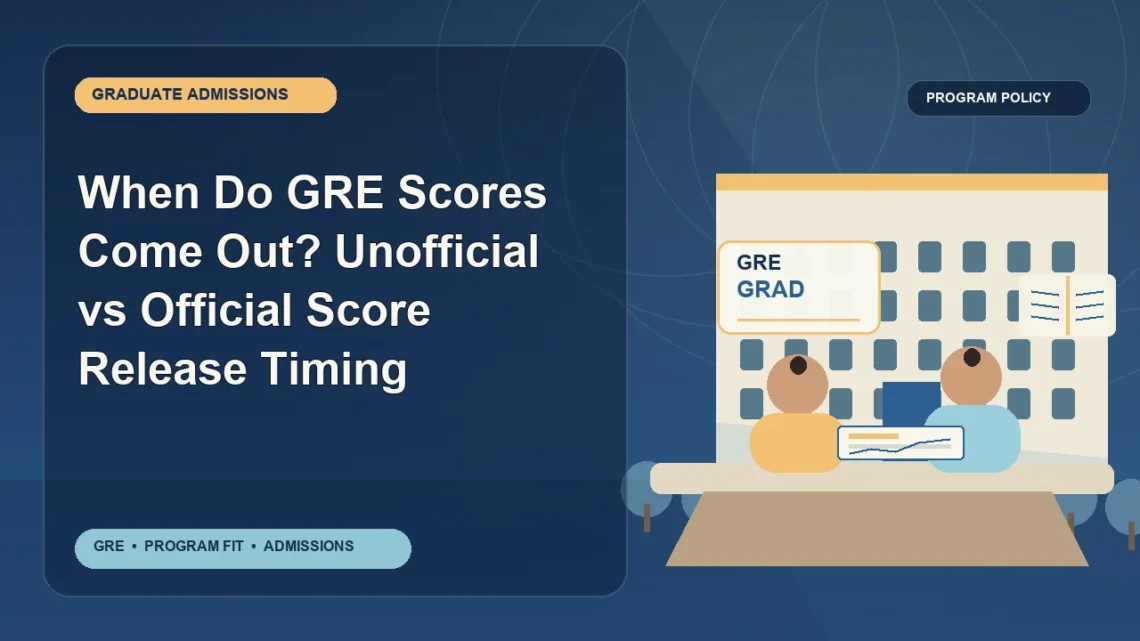
GRE scores do not usually come out on the same day for your official record. For the GRE General Test, you will typically see your unofficial Verbal Reasoning and Quantitative Reasoning scores at the end of the test, but your official scores, including Analytical Writing, are reported later through your ETS account. Exact score reporting timelines can change, so you should always confirm the current timing on the official ETS website, especially if you are planning around application deadlines.
Quick Answer
If you are asking when do GRE scores come out, the short answer is this: for the GRE General Test, you usually see unofficial Verbal and Quant scores immediately after finishing the exam, and your official scores are posted to your ETS account later. Those official scores are also what schools receive through score reporting. Because reporting timelines and delivery processes may be updated by ETS, verify current details directly with ETS before scheduling a test close to an admissions deadline.
Why This Matters
Your score release date affects much more than your curiosity after test day. It can influence when you schedule your exam, whether you leave enough time for a retake, and whether your scores reach graduate programs before their deadlines.
This topic matters because:
- Application timing depends on it. If scores arrive later than expected, you may miss a priority or final deadline.
- Retake planning depends on it. You need time to review your results and decide whether to test again.
- Score reporting is separate from test day. Seeing an unofficial score on screen is not the same as having an official report available to schools.
- Analytical Writing takes additional processing. That is one reason official scores are not available immediately.
- International and at-home testers may want extra buffer time. If you are applying across countries or testing near holidays or deadlines, planning ahead becomes even more important.
For many graduate applicants, score timing is not just an administrative detail. It is part of the application strategy.
Main Explanation
What “GRE scores come out” actually means
When people ask when GRE scores come out, they may mean one of several different things:
- When you can see any score at all after the exam
- When your official scores are posted in your ETS account
- When designated schools receive your scores
- When score reports become usable for admissions
These are related, but they are not identical.
Unofficial scores vs official scores
For the GRE General Test, ETS typically shows unofficial Verbal Reasoning and Quantitative Reasoning scores at the end of the exam. These scores give you a quick sense of your performance, but they are not the complete official score report.
Your official score report is the version that appears in your ETS account after processing. It typically includes:
- Verbal Reasoning
- Quantitative Reasoning
- Analytical Writing
- Percentile information, when applicable
- The report schools receive through ETS score reporting
The Analytical Writing score is one reason official scores are not immediate. That section requires evaluation after the test, so your full report takes longer than the on-screen unofficial scores.
When unofficial GRE scores appear
For the GRE General Test, unofficial Verbal and Quant scores usually appear at the end of the testing session, before you leave the system. This applies to the General Test format, whether taken at a test center or at home, when ETS provides that immediate unofficial display.
Important points:
- Unofficial scores are not the final report schools use.
- You may not receive an unofficial score for every section or every GRE product.
- If testing is interrupted or flagged for review, score availability may differ.
- The GRE Subject Tests follow a different reporting process than the General Test.
When official GRE scores are released
Official GRE scores are typically posted to your ETS account after ETS completes score processing. ETS publishes official guidance about score availability, and those timelines can change. Rather than relying on older forum posts or outdated advice, check the official ETS score reporting page when planning your test date.
In practical terms, you should assume:
- Your official score report will come after test day, not immediately.
- Schools receive official scores through the ETS reporting process, not from your unofficial on-screen result.
- Application planning should include a safety buffer in case processing takes longer than you hoped.
When schools receive GRE scores
Another common source of confusion is the difference between scores posted to your ETS account and scores received by institutions. Even after your official report is ready, schools may need additional processing time on their side.
That means there can be several stages:
- You complete the GRE.
- You see unofficial Verbal and Quant scores, if applicable.
- ETS posts your official scores in your account.
- ETS sends score reports to your designated institutions.
- The graduate program processes and matches the score to your application file.
If an admissions office says your scores are missing, the delay may not always be with ETS. Sometimes the school has received them but has not yet linked them to your application.
Do test center and at-home scores come out at different times?
ETS policies can change, so you should verify current details. In general, score reporting for the GRE General Test follows the ETS processing schedule regardless of whether you test at a center or at home. However, at-home testing can involve additional review in some situations, especially if there are check-in issues, technical interruptions, or exam integrity reviews.
That does not mean most at-home testers will face delays. It simply means that if anything unusual happens during the session, score timing may be affected.
What about GRE Subject Test scores?
GRE Subject Tests do not follow exactly the same score release pattern as the General Test. If you are taking a Subject Test, do not assume that immediate unofficial score viewing will work the same way. Subject Test score reporting may follow a different schedule set by ETS for that testing program.
If your question is specifically about a Subject Test, check the official ETS Subject Test pages for the current reporting calendar and score release process.
Requirements, Rules, and Eligibility
What you need in order to receive GRE scores
You generally need the following for your GRE scores to be processed and accessible:
- A valid ETS account with accurate personal information
- A completed GRE test session that was not canceled, terminated, or invalidated
- Matching identification information between registration and test-day ID
- Compliance with ETS testing rules and security procedures
Identification requirements that affect score reporting
Although ID rules are mostly discussed in relation to test-day admission, they also matter for score reporting. If there is a significant mismatch between your registered name and your accepted ID, you may not be allowed to test. In that case, there would be no valid score report from that session.
Common ID considerations include:
- Your name on your ETS account should match your official identification.
- International test takers often need to follow passport-related rules, depending on ETS policies and country-specific requirements.
- Expired or unacceptable ID can prevent testing.
- Small name differences can create serious problems, especially if they affect identity verification.
Because ID policies can vary by location and may be updated, verify your exact ID requirements on the ETS website before test day.
Registration requirements related to score release
Score release depends on a valid registration record. Problems during registration can delay later steps. Make sure:
- Your legal name is entered correctly.
- Your date of birth and contact information are accurate.
- Your testing format and test date are correct.
- You save confirmation emails and appointment details.
Testing requirements that can affect score availability
Your scores may be delayed, withheld, or otherwise affected if:
- Your test session is interrupted and cannot be completed normally.
- There are technical problems during an at-home exam.
- ETS reviews your test for administrative or security reasons.
- You cancel your scores, if that option is available under the applicable ETS rules.
Not every issue results in a delay, but any unusual testing event can change the normal reporting timeline.
Technical requirements for at-home testing
If you take the GRE at home, technical compliance matters because a disrupted session can affect whether scores are processed on the normal timeline. Depending on current ETS and proctoring rules, at-home requirements may include:
- A suitable computer setup
- Reliable internet access
- A functioning camera and microphone
- An acceptable testing room and desk area
- Completion of the required check-in and security procedures
Always review the official ETS at-home testing requirements shortly before your exam. Technical rules can change.
Step-by-Step Process
How GRE score reporting typically works
- Register for the GRE. Use your legal name exactly as required by ETS and make sure your account information is accurate.
- Take the test. Follow all ETS procedures, whether testing at a center or at home.
- View unofficial scores, if provided. For the GRE General Test, you will usually see unofficial Verbal and Quant scores at the end of the exam.
- Wait for official score processing. ETS completes scoring and posts the official report to your account.
- Check your ETS account. Look for your official score report rather than relying only on your memory of the unofficial scores.
- Confirm score recipients. If you designated schools, ETS sends official reports through its reporting system.
- Monitor your application portals. Schools may need time to match scores to your application.
- Follow up if needed. If your scores appear in ETS but not in a school portal after a reasonable period, contact the institution first and then ETS if necessary.
How to plan your GRE date around score release
- Identify your earliest application deadline.
- Check ETS’s current official score reporting timeline.
- Build in extra time. Leave a buffer for score processing, school processing, and possible technical issues.
- Add retake space if possible. If you want the option to test again, schedule your first GRE well before deadlines.
- Confirm each program’s policy. Some schools care about when scores are received, while others may accept self-reported scores initially.
How to verify whether your scores were sent
- Log into your ETS account.
- Open your score reporting or testing history section.
- Review your score report availability.
- Check whether recipient institutions were selected.
- Compare that information with your school application portal.
- Contact the admissions office if the school portal still shows your scores as missing.
Common Problems and Solutions
Problem: You saw unofficial scores, but official scores are not in your account yet
What may be happening: This is often normal if you are checking too soon. Unofficial scores appear first, while official scores require additional processing.
What to do:
- Check the current ETS timeline for official score release.
- Wait until the expected reporting window has passed.
- Make sure you are logging into the correct ETS account.
Problem: A school says it has not received your GRE scores
What may be happening: The score report may still be in transit, or the school may have received it but not yet matched it to your file.
What to do:
- Confirm that your official scores are available in ETS.
- Verify that you selected the correct institution and department, if applicable.
- Check whether the school uses self-reported scores first and official scores later.
- Contact the admissions office with your full name, application ID, and test date.
Problem: Your name does not match your identification
What may be happening: A mismatch can prevent test-day admission or create identity verification problems.
What to do:
- Review your ETS profile before test day.
- Use your legal name exactly as required by ETS.
- If you notice an error early, contact ETS and review the official correction options.
Problem: At-home testing had technical issues
What may be happening: A disrupted testing session can affect score processing or require review.
What to do:
- Keep records of the issue, including emails or case numbers.
- Monitor your ETS account for updates.
- Contact ETS if the normal reporting timeline passes without information.
Problem: You are testing close to a deadline
What may be happening: Even if scores are released on the expected timeline, schools may need extra time to process them.
What to do:
- Do not assume same-day or next-day usability of your scores.
- Check with each graduate program about how they handle pending official reports.
- Whenever possible, test earlier than the minimum timeline suggests.
Problem: You are comparing advice from old websites and forums
What may be happening: GRE policies, formats, and reporting timelines can change over time.
What to do:
- Use ETS as your primary source.
- Treat unofficial online discussions as secondary guidance only.
- Verify any deadline-sensitive detail directly with ETS and your target schools.
Practical Examples and Scenarios
Scenario 1: A student wants to apply in December
Maria plans to submit graduate applications in early December. She wonders whether taking the GRE in late November is safe. Even if ETS posts official scores within its normal reporting window, the timing may be too tight once school processing is considered. A better strategy would be to test earlier, leaving time for score release, score delivery, and a possible retake.
Scenario 2: A student sees unofficial scores and assumes schools have them
Daniel finishes the GRE General Test and sees his Verbal and Quant scores on screen. He assumes his universities can already view them. That is incorrect. The on-screen result is unofficial. His schools need the official ETS score report, which will be available later after processing.
Scenario 3: A student’s application portal says “scores missing”
Neha’s ETS account shows that her official GRE scores are available, but one university portal still lists them as missing. In this case, the most likely issue is internal school processing. She should contact the admissions office, provide her identifying details, and ask whether the scores are waiting to be matched to her file.
Scenario 4: A student has an at-home testing interruption
Omar takes the GRE at home, but his internet connection drops briefly during the session. Even if he completes the exam, he should be prepared for the possibility of additional review. That does not guarantee a delay, but it means he should monitor his account closely and avoid assuming his scores will follow the exact standard timeline.
Scenario 5: A student registered with a nickname
Sophia registers using “Sophie,” but her passport shows “Sophia.” Depending on ETS identification rules and the exact mismatch, she could face problems at check-in. If she is not admitted to test, there will be no score release from that appointment. This is why name accuracy matters long before score reporting begins.
Comparison Table
| Situation | What You See | When It Happens | Who Can Use It | Key Limitation |
|---|---|---|---|---|
| End of GRE General Test | Unofficial Verbal and Quant scores | Immediately after the exam, if provided by ETS | Mainly the test taker | Not the complete official report |
| Official ETS score report | Official Verbal, Quant, and Analytical Writing scores | After ETS processing | Test taker and institutions through ETS | Requires waiting beyond test day |
| School application portal | Status showing scores received or pending | After ETS sends scores and the school processes them | Applicant and admissions office | May lag behind ETS availability |
Test center vs at-home score timing considerations
| Format | Unofficial Scores | Official Scores | Special Considerations |
|---|---|---|---|
| Test center GRE General Test | Usually shown at the end of the test | Posted later through ETS | Fewer home technology variables, but normal ETS processing still applies |
| GRE at Home General Test | Usually shown at the end of the test if the session is completed normally | Posted later through ETS | Technical issues or review processes may affect timing in some cases |
Frequently Asked Questions
Do GRE scores come out immediately?
Not fully. For the GRE General Test, unofficial Verbal and Quant scores usually appear at the end of the exam, but official scores are released later through your ETS account.
When do schools receive GRE scores?
Schools receive official scores through ETS after your score report is processed. The exact timing can vary, and schools may need extra time to match scores to your application.
Can I use my unofficial GRE scores for applications?
Some programs may allow self-reported scores during the application process, but official admissions review often still requires official ETS reports. Check each school’s policy carefully.
Why is the Analytical Writing score not immediate?
Analytical Writing requires additional evaluation, so it is included in the official score report rather than the immediate unofficial score display.
Are at-home GRE scores delayed compared with test-center scores?
Not necessarily. Standard score processing is generally similar, but unusual events such as technical issues or exam reviews could affect timing. Always check current ETS guidance.
What if my scores are not available when ETS says they should be?
First confirm that you are checking the correct ETS account and that the expected reporting window has actually passed. If it has, contact ETS and review whether any testing irregularity may have affected your score release.
Do GRE Subject Test scores come out the same way as General Test scores?
No, they may follow a different reporting schedule and process. Check the official ETS Subject Test information for current details.
Should I take the GRE close to my application deadline?
It is usually safer to test earlier. Even if ETS releases scores on schedule, schools may need additional processing time, and you may want the option to retake the exam.
What if a university cannot find my GRE scores?
Contact the admissions office first and provide your name, application ID, and test date. In many cases, the school has the report but has not yet matched it to your file.
How can I avoid score reporting problems?
Register with the correct legal name, verify your ID requirements, test well before deadlines, and monitor both your ETS account and each school portal.
Important Notes
- Policies may change. ETS can update score reporting timelines, testing procedures, and at-home requirements.
- Country-specific rules may differ. International test takers should review local availability and ID rules carefully.
- Do not rely on unofficial timelines alone. Old blog posts, forum comments, and social media advice may be outdated.
- School processing is separate from ETS processing. A university portal may update later than your ETS account.
- Application strategy matters. If a deadline is important, build in extra time rather than aiming for the last possible test date.
- Use ETS as the official source. For current details on score release, score reporting, test formats, and identification rules, verify information directly on the ETS website.
Related GRE Topics to Review
If you are planning your testing timeline, it can also help to review related topics such as GRE registration, GRE identification requirements, sending GRE scores to schools, GRE at Home policies, and whether programs accept self-reported GRE scores during the admissions process. These topics can help you avoid last-minute problems and better understand how the full testing and application process fits together.
Final Thoughts
If you are wondering when GRE scores come out, the most important distinction is between unofficial scores on test day and official scores released later by ETS. For the GRE General Test, you will usually see unofficial Verbal and Quant scores right away, but your complete official report, including Analytical Writing, takes additional time. The safest approach is to test early, monitor your ETS account, verify your school requirements, and confirm current timelines directly with ETS before making deadline-sensitive decisions.