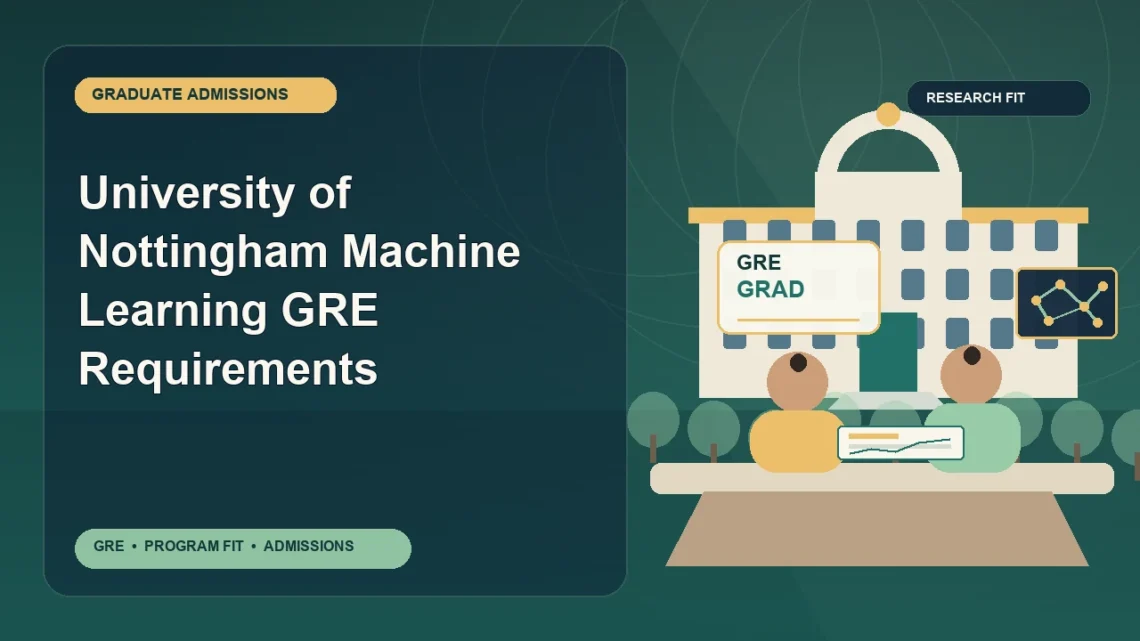
If you are looking for the University of Nottingham machine learning GRE requirements, the key point is that you should verify the exact policy at the program level. Universities often set graduate admissions rules centrally, but individual departments and course pages may have their own expectations for test scores, academic background, and supporting materials. For applicants to machine learning, that distinction matters because some programs treat the GRE as required, some as optional, and some do not use it at all.
For the University of Nottingham, applicants should review the specific course page and the relevant admissions office guidance before applying. If a machine learning degree is offered through a particular school or department, the GRE policy may depend on that unit rather than the university as a whole. If the program does not publicly publish a GRE rule, the safest assumption is not to guess. Instead, confirm directly with the department or postgraduate admissions team.
Program and Admissions Overview
Machine learning graduate study at the University of Nottingham is typically aimed at students who want advanced training in data-driven methods, artificial intelligence, statistics, optimization, and computational problem-solving. Depending on the exact course, applicants may be applying to a taught master’s program, a research master’s degree, or a PhD with machine learning focus. The admissions expectations can differ significantly across those pathways.
For a taught master’s degree, the university usually looks for strong evidence that you can handle advanced technical coursework. That often means prior study in computer science, mathematics, statistics, engineering, physics, or a closely related field. For a PhD, the focus is usually broader and more research-oriented. Admissions committees typically want to see a strong academic record, a clear research fit, and preparation for independent study.
Because “machine learning” can appear in multiple departments, applicants should identify the exact program first. It may be housed in a school such as computer science, engineering, or an interdisciplinary AI group. The correct admissions page should name the degree, outline the entry standards, and explain whether standardized tests such as the GRE are used.
Current GRE Policy
The University of Nottingham does not publicly publish a universal GRE requirement for all machine learning-related graduate programs. In practice, that means the GRE may be:
- Not considered for some programs
- Optional for some applicants
- Recommended in specific cases
- Required only if a particular course page or department states so
Because policies can vary by school, degree type, and applicant background, you should not assume that the GRE is necessary unless the program explicitly says so. If the course page is silent on the GRE, that usually means the university does not prominently rely on it for that program, but you should still confirm before submitting an application.
When a university does not publish GRE rules clearly, the most accurate guidance is to contact the admissions office or department directly. Ask whether the GRE is considered, whether it is optional, and whether submitting scores could strengthen an application in any way.
How to interpret an unclear GRE policy
If you find conflicting information across university pages, older brochures, or third-party sites, treat the official course page as the primary source. Admissions policies can change. A page from a previous academic cycle may no longer be current, even if it still appears online.
For a competitive subject like machine learning, applicants sometimes wonder whether a GRE score can compensate for a weaker transcript. That is not something you should assume. At universities that do not require the GRE, strong academic preparation, relevant technical coursework, and a convincing fit with the program are usually more important than test scores.
Academic Requirements
Most machine learning applicants to the University of Nottingham should expect a strong academic threshold, even when a GRE is not required. Graduate-level machine learning programs are mathematically demanding, so admissions reviewers often look for preparation in areas such as linear algebra, calculus, probability, statistics, programming, and algorithmic thinking.
Typical academic background
While exact requirements vary by degree, suitable backgrounds often include:
- Computer science
- Mathematics
- Statistics
- Data science
- Engineering
- Physics or other quantitative disciplines
Applicants from less directly related fields may still be considered if they can demonstrate enough quantitative coursework or professional experience. In that case, the department may look closely at your transcript to assess whether you are ready for the technical content of the program.
Master’s applicants
For a master’s in machine learning or a closely related subject, the university is usually looking for evidence that you can succeed in advanced taught modules and project work. A strong undergraduate degree in a relevant field is often the most important academic factor. If your background is mixed, it helps to show consistency in math and computing coursework.
PhD applicants
For a PhD, the admissions process is more research-focused. In addition to strong academic preparation, applicants are often expected to show:
- A well-developed research interest
- Familiarity with machine learning literature or methods
- Potential supervisor fit
- Evidence of independent thinking
In many PhD applications, a prior dissertation, research project, or publication can strengthen the case for admission. If the University of Nottingham department is seeking a specific research profile, the match between your interests and faculty expertise may matter more than any standardized test.
Program-Specific Expectations
Machine learning degrees are not all the same. At the University of Nottingham, the exact expectations will depend on whether the program emphasizes theory, software development, data science applications, or research training. Applicants should review module descriptions and dissertation requirements carefully.
What admissions teams usually look for in machine learning applicants
- Mathematical readiness, especially in linear algebra, probability, and statistics
- Programming ability, often in Python or other relevant languages
- Analytical skill, including problem solving and model-based reasoning
- Evidence of interest in AI, machine learning, or computational methods
- Research fit, especially for PhD applicants
If the course includes a substantial dissertation or research project, the admissions team may want to see that you can formulate a technical question, work with data, and communicate results clearly.
Course structure considerations
Before applying, review whether the program is primarily:
- Taught, with lectures, seminars, and assessed assignments
- Research-based, with a thesis or dissertation as the central component
- Industry-facing, with applied projects or professional relevance
That structure matters because it affects how your application is evaluated. A taught program may emphasize transcript strength and academic readiness. A research program may place more weight on your proposed topic, prior research experience, and alignment with a supervisor.
Faculty alignment
For PhD applicants in particular, faculty alignment can be decisive. If your proposed work involves areas such as deep learning, computer vision, probabilistic modeling, natural language processing, or reinforcement learning, it helps if the department has staff working in or near those fields. Review faculty profiles and recent research before naming a potential supervisor.
Competitiveness and Applicant Profile
Machine learning is usually a competitive or highly competitive graduate field because many applicants have strong technical backgrounds and because the subject area is in high demand. The University of Nottingham’s competitiveness will vary by program, but applicants should expect a holistic admissions process rather than a single-score decision.
Since the university does not publicly publish machine learning-specific GRE averages, acceptance rates, or score thresholds for this topic, it would be inaccurate to estimate those figures. Instead, you should think in terms of overall applicant strength.
What a strong application often includes
- A relevant and rigorous academic record
- Evidence of competence in mathematics and programming
- Clear motivation for studying machine learning
- Relevant project, internship, or research experience
- A focused reason for choosing the University of Nottingham
For master’s applicants, admissions reviewers may prioritize whether you are prepared for the curriculum. For PhD applicants, they may focus more on whether your research interests are realistic, specific, and aligned with available supervision.
How the GRE fits into competitiveness
If the GRE is not required, submitting a score usually only makes sense if it adds useful evidence to the application. For example, a strong quantitative score may help demonstrate readiness for a mathematically intense program. However, if the department does not consider the GRE, or if it is optional but not emphasized, your transcript and subject preparation may matter more.
If the GRE is required for a particular course, then the score becomes a formal part of the admissions review. In that case, verify whether the department has any section preferences, validity rules, or reporting instructions.
International Applicant Considerations
International applicants to machine learning programs at the University of Nottingham should pay close attention to English language requirements, degree equivalency, and document formatting. These requirements can affect both eligibility and timing.
English language proficiency
If English is not your first language, the university may ask for proof of proficiency through an approved test or other accepted evidence. The exact accepted tests and score requirements are set by the university and program. Because these details can change, applicants should check the official course page rather than relying on third-party summaries.
Transcripts and credential review
International applicants may need to provide transcripts in the original language plus certified translations if applicable. The admissions team will typically evaluate whether your degree is equivalent to the entry standard for the program. For technical subjects like machine learning, course content may matter as much as the degree title itself.
Additional documentation
Depending on your background, you may also need to submit:
- A degree certificate or provisional award letter
- A CV or résumé
- A personal statement or research proposal
- References or letters of recommendation
- Portfolio material, if requested by the department
If you are applying from outside the United Kingdom, allow extra time for transcript verification, English test scheduling, and visa preparation after admission. The university may also require financial documentation for visa purposes once you receive an offer.
Funding and visa planning
If funding, scholarships, or assistantships are available, the program or university will usually state this on the official website. The University of Nottingham does not publicly publish a machine learning-specific funding rate that can be cited broadly here, so you should review current departmental funding pages and scholarship deadlines separately.
Required vs. Optional Materials: What to Expect
| Application Component | Why It Matters | What to Check |
|---|---|---|
| Academic transcripts | Shows subject preparation and academic performance | Degree level, relevant modules, and grading scale |
| GRE score | Only relevant if the program uses it | Whether it is required, optional, or not considered |
| English proficiency evidence | Required for many international applicants | Accepted tests and minimum scores on the official page |
| Personal statement or research proposal | Explains fit and motivation | Whether the program wants a taught-course statement or a research proposal |
| References | Support your readiness and character | Number of referees and format requirements |
| CV or résumé | Highlights relevant experience | Whether it is required for your degree type |
How to Assess Your Fit for the University of Nottingham
If you are considering a machine learning program at the University of Nottingham, a practical way to judge fit is to compare your preparation against the program’s technical demands.
Good signs that you may be a strong fit
- You have studied mathematics, statistics, or computing at a substantial level.
- You can discuss machine learning topics beyond general interest.
- Your prior projects show analytical or coding experience.
- You can explain why this specific program matches your academic goals.
- For PhD study, you can identify a potential research direction and supervisor.
Possible gaps to address before applying
- Limited coursework in probability or linear algebra
- Little or no programming experience
- A subject background that is far from quantitative fields
- Unclear research goals for doctoral study
- Missing English language evidence for international admission
If you identify gaps, do not assume the GRE will solve them. At many universities, a strong test score cannot fully offset major deficiencies in academic preparation. A better strategy is to strengthen the parts of the application that the program values most.
Frequently Asked Questions
Does the University of Nottingham require the GRE for machine learning?
The university does not publicly publish a universal GRE requirement for all machine learning-related graduate programs. Check the exact course page and contact the department if the policy is unclear.
If the GRE is not required, should I still take it?
Only if you believe it will add value to your application. If the program does not use GRE scores, your time is usually better spent improving your transcript, programming portfolio, research profile, or English proficiency evidence, depending on your situation.
Are there minimum GRE scores for machine learning at Nottingham?
The university does not publicly publish machine learning-specific minimum GRE scores. If a department ever uses GRE results, look for the official score guidance on the course page or in direct admissions communication.
What academic background do I need?
A strong background in computer science, mathematics, statistics, engineering, physics, or another quantitative field is often the best preparation. The exact requirements depend on the specific program.
Is machine learning admission at Nottingham competitive?
It is generally best to view machine learning as a competitive field. The admissions process is usually holistic and based on academic readiness, subject preparation, and program fit.
Do international students need extra documents?
Often yes. International applicants may need English language proof, certified transcripts, translated documents if applicable, and visa-related financial documentation after an offer is made.
Final Thoughts
For applicants searching for the University of Nottingham machine learning GRE requirements, the most important takeaway is that the GRE policy is not something you should assume. The university does not publicly publish a single GRE rule that applies to all machine learning programs, so the exact requirement depends on the specific department and degree.
What matters most for admission is usually your academic preparation, quantitative background, programming ability, and fit with the program’s structure. For PhD applicants, research alignment and supervisor match can be especially important. For international applicants, English proficiency and credential review are also central parts of the process.
Before applying, review the official course page carefully, confirm whether the GRE is required or considered, and make sure your materials match the expectations of the specific machine learning program you want to join.