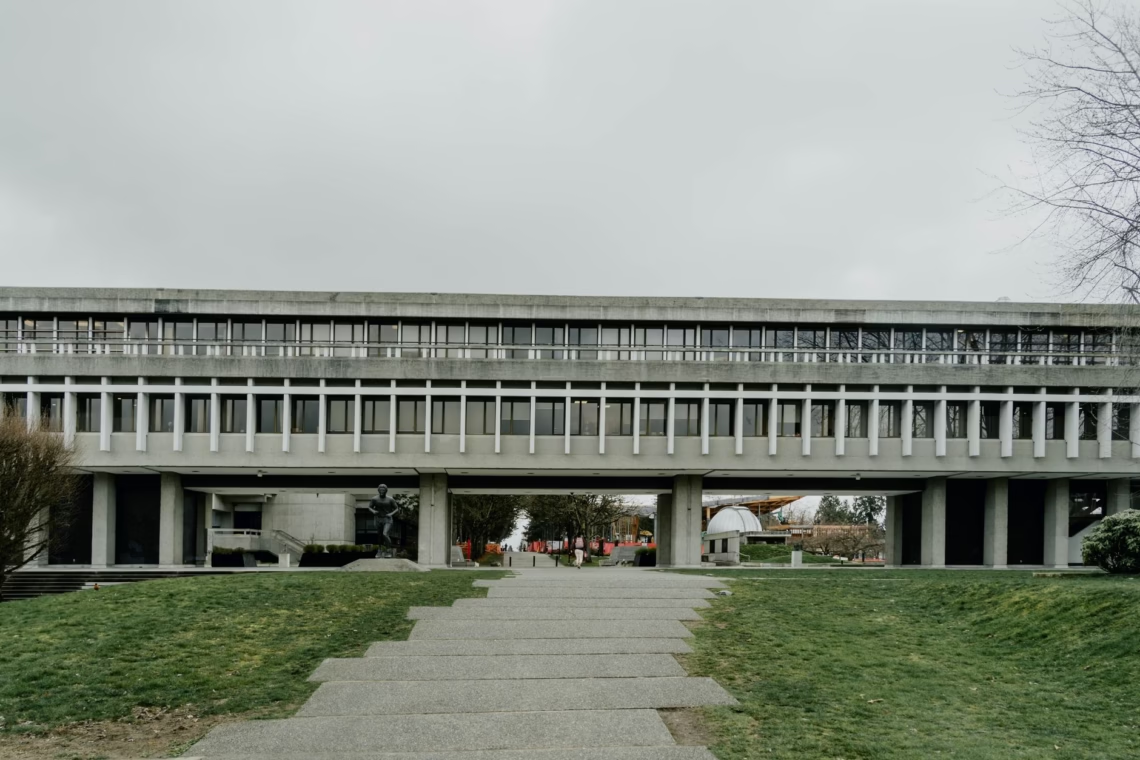
If you are researching Simon Fraser University electrical engineering GRE requirements, the most important thing to know is that GRE policies can vary by program, degree level, and applicant background. In many cases, the clearest answer is found in the specific department page rather than a university-wide rule. For that reason, applicants to Simon Fraser University should verify the current GRE policy directly with the Electrical Engineering graduate program and the university’s admissions office before applying.
What prospective applicants usually want to know is whether the GRE is required, recommended, optional, or not considered, and how much weight it carries in admissions decisions. For Simon Fraser University’s electrical engineering graduate options, the admissions process is typically based on academic preparation, relevant background, letters, research interests, and program fit. If GRE scores are accepted or requested, they are usually only one part of a broader review.
Program and admissions overview
Simon Fraser University, commonly known as SFU, is a major Canadian research university with graduate programs in engineering that attract both domestic and international applicants. The electrical engineering graduate pathway is designed for students who want advanced study in areas such as communications, signal processing, electronics, control systems, power systems, embedded systems, and related research fields. Depending on the department’s current offerings, applicants may pursue a thesis-based master’s degree, a course-based master’s degree, or a PhD.
For applicants searching specifically for GRE requirements, it is helpful to understand that engineering graduate admissions are usually reviewed holistically. That means the admissions committee looks at more than test scores alone. A strong academic record in engineering or a closely related field often matters more than any single test, especially when the program is research-oriented.
Because university policies can change, the safest approach is to treat the GRE as a program-specific requirement that must be confirmed on the official SFU graduate admissions pages or through the electrical engineering graduate program directly.
Typical components of the application
While exact requirements can differ by degree and applicant type, electrical engineering applicants are commonly asked for the following:
- Academic transcripts from all post-secondary institutions attended
- Statement of intent or research interest statement, especially for thesis-based study and PhD applications
- Letters of recommendation
- Resume or curriculum vitae
- English language proficiency evidence if required
- GRE scores, if the program currently requests or accepts them
- Supplementary material if the department asks for it, such as a portfolio of research experience or contact with a potential supervisor
Applicants should check whether the program expects direct supervisor alignment for thesis-based study. In research-heavy departments, identifying a faculty member whose interests match yours can be especially important.
Current GRE policy
At the time of application, do not assume that the GRE is required unless the official program instructions say so. For SFU electrical engineering, the GRE policy may be stated in one of several ways:
- GRE required: scores must be submitted with the application
- GRE recommended: scores are not mandatory, but may strengthen an application in some cases
- GRE optional: applicants may submit scores if they believe the results help their file
- GRE waived: the department does not require the GRE for admissions
- GRE not considered: scores are not reviewed as part of the admission process
If the official SFU Electrical Engineering graduate admissions page does not clearly state one of these categories, then the correct answer is that the university does not publicly publish this information in a way that is easy to confirm, and applicants should verify directly with the department.
This distinction matters because many applicants search for a single university-wide GRE answer when the real policy is program-specific. One department may accept scores, another may not use them at all, and a third may ask for them only under certain conditions, such as for applicants from non-engineering backgrounds.
How to interpret an unclear GRE policy
If the department page uses broad language like “additional materials may be requested” or “standardized test scores may be considered,” that is not the same as a formal requirement. In that situation, you should contact the graduate program office and ask:
- Whether the GRE is required for my degree level
- Whether it is required for international applicants
- Whether it is required for thesis-based or PhD applicants only
- Whether scores are optional and, if so, how much weight they receive
- Whether old GRE scores are accepted and for how long
If you are comparing SFU with other Canadian universities, note that many engineering departments in Canada place less emphasis on the GRE than some U.S. programs do. However, policies vary widely, so you should not generalize from one school to another.
Academic requirements
For electrical engineering graduate study, admissions committees look closely at your academic preparation. A strong undergraduate background in electrical engineering is the most straightforward path, but applicants from related disciplines such as computer engineering, physics, applied mathematics, or computer science may also be considered if their coursework aligns with the program.
Undergraduate preparation
Applicants are usually expected to have completed substantial coursework in subjects that support graduate engineering study. Depending on the specialization, this may include:
- Circuits
- Electromagnetics
- Signals and systems
- Control theory
- Digital systems
- Programming
- Mathematics, including calculus, linear algebra, and differential equations
For thesis-based or doctoral study, the department may expect evidence that you can handle research-level work, not just coursework. That can come from undergraduate research, co-op experience, a senior design project, or prior graduate-level study.
GPA and academic standing
SFU may have minimum academic standards for admission, but applicants should always check the current university and department pages for the exact thresholds. If the university does not publicly publish a specific minimum for the electrical engineering program, it is best to say so rather than assume a cutoff.
In practice, a competitive applicant usually shows:
- Consistent performance in upper-level technical courses
- Few weak grades in core engineering subjects
- Evidence of readiness for advanced analytical work
- A transcript that supports the intended area of study
If your undergraduate GPA is lower than you would like, a strong graduate coursework record, research experience, or relevant work experience may help offset concerns. That said, no application can rely on one strength alone.
Degree-specific expectations
Master’s applicants are typically assessed on their readiness for advanced study in a defined technical area. A thesis-based master’s application may place more emphasis on research fit and supervisor interest.
PhD applicants usually need stronger evidence of research potential. That can include prior thesis work, publications, technical projects, research assistant experience, or a master’s degree in a related field.
Applicants should also determine whether the department offers direct entry from a bachelor’s degree to the PhD, or whether a master’s degree is normally expected first. If that information is not clearly published, ask the department directly.
Program-specific expectations
Electrical engineering is a broad field, and SFU applicants should tailor their files to the area they want to study. The department may value different preparation depending on whether you are interested in communications, devices, systems, signal processing, or another specialization.
Research alignment matters
For thesis-based master’s and PhD applications, faculty alignment is often one of the most important factors. The committee wants to know whether your interests connect to ongoing research in the department. This is especially true if admission depends on supervisor availability.
When reviewing SFU electrical engineering, it is wise to identify:
- Faculty whose research overlaps with your interests
- Labs or research groups that match your background
- Projects that connect to your long-term goals
- Courses or prior experiences that prepared you for that research area
Applicants who can clearly explain this alignment often present a stronger case than applicants who simply list broad interest in “electrical engineering.”
Course-based versus thesis-based study
If SFU offers both course-based and thesis-based graduate pathways in electrical engineering, the admissions expectations may differ.
| Pathway | Typical emphasis | GRE relevance |
|---|---|---|
| Course-based master’s | Advanced coursework, professional development, technical depth | May be less important if not required |
| Thesis-based master’s | Research potential, supervisor fit, academic preparation | Could matter if the department requests it |
| PhD | Independent research ability, prior publications or thesis work, faculty fit | Usually secondary to research credentials unless required |
Because program structure can change, applicants should review the current SFU calendar and department page for the exact degree options available in electrical engineering.
English proficiency and international preparation
Applicants whose previous education was not in English may need to provide English language test scores. This is separate from the GRE. Common tests include TOEFL or IELTS, but the exact accepted tests and minimums must be confirmed on the official SFU admissions page. Do not assume that graduate engineering requirements are identical across programs.
International students should also make sure their transcripts, grading scales, and degree credentials are clearly documented. If the university requires certified translations or credential evaluation, that information will usually appear in the graduate admissions instructions.
Competitiveness and applicant profile
SFU electrical engineering is best described as a competitive or selective graduate program, especially for thesis-based and PhD study where supervisor availability and research fit matter. The process is usually holistic, meaning the committee considers several parts of the application together rather than using only one metric.
Because the university does not publicly publish many of the admissions statistics that applicants often look for, such as acceptance rate, average GRE score, or average GPA, it is not appropriate to guess. The university does not publicly publish this information. Applicants should instead focus on presenting a well-matched and well-supported application.
What makes an applicant competitive
A strong applicant to SFU electrical engineering often has several of the following:
- A degree in electrical engineering or a closely related field
- Strong grades in core technical subjects
- Research or project experience related to the intended specialization
- Clear evidence of interest in the department’s research areas
- Letters that speak to technical ability and research potential
- For international applicants, strong English proficiency evidence if needed
For PhD applicants, published research, a thesis, or a strong master’s record can be especially helpful. For master’s applicants, a solid undergraduate transcript and a clear academic direction often carry significant weight.
How GRE scores may affect competitiveness
If the GRE is required or accepted, a strong score may help demonstrate quantitative readiness, especially for applicants whose transcripts are hard to compare across institutions. However, in a specialized engineering program, GRE results rarely substitute for a weak academic record in core technical courses.
If the GRE is optional, submitting a score usually makes the most sense only if it supports your application. If your score is not strong, you may be better off not using it unless the department specifically asks for it.
Because SFU may not publicly describe how much weight the GRE carries, applicants should not assume that a high score guarantees admission or that a missing score automatically hurts an application.
International applicant considerations
International applicants to SFU electrical engineering should pay special attention to documentation requirements, language testing, and degree equivalency. These issues are separate from GRE policy, but they often affect whether an application is complete and reviewable.
Transcript and credential review
Graduate admissions committees want to see what courses you took, what grades you earned, and whether your prior degree is comparable to the expected preparation for graduate engineering work. If your transcripts use a grading system unfamiliar in Canada, the admissions office may review them in context rather than by simple numerical conversion.
English language proficiency
If English is not your first language or your previous degree was not taught in English, the university may require proof of English proficiency. Since these requirements can change, confirm the accepted test types, score minimums, and exemptions directly through SFU.
Funding and visa planning
International applicants should also think about funding and immigration documentation early. If you receive an offer with financial support, you may need that information for study permit planning. If the department offers assistantships, fellowships, or supervised research funding, the details should come from the official program or faculty pages. The university does not publicly publish all funding statistics, so applicants should not rely on informal estimates.
Frequently asked questions
Does Simon Fraser University require the GRE for electrical engineering?
The current GRE policy must be confirmed on the official SFU electrical engineering graduate admissions page or with the department directly. If the policy is not clearly stated, the safest conclusion is that applicants should verify the requirement before applying.
Is the GRE required for all graduate engineering applicants at SFU?
Not necessarily. Graduate test policies can vary by department, degree level, and applicant background. Do not assume that one engineering program’s rule applies to all others at SFU.
Will a high GRE score improve my chances?
It may help if the program accepts or requests the GRE, but it is only one part of the file. For electrical engineering, academic preparation and research fit are usually more important.
What matters most for a thesis-based application?
For a thesis-based master’s or PhD application, the most important factors usually include technical preparation, research alignment, and evidence that you can succeed in advanced study. Faculty fit can be especially important.
Does SFU publish average GRE scores for electrical engineering?
The university does not publicly publish this information.
Does SFU publish acceptance rates for electrical engineering graduate programs?
The university does not publicly publish this information.
What should I do if I cannot find a clear GRE rule?
Contact the graduate program directly and ask for the current policy in writing. That is the most reliable way to avoid submitting unnecessary materials or missing a required component.
Final thoughts
If you are evaluating Simon Fraser University electrical engineering GRE requirements, the key point is to confirm the program’s current policy directly rather than rely on general assumptions. The GRE may be required, optional, waived, or not considered, depending on the exact SFU program and degree pathway. For most applicants, however, the stronger indicators of admission potential are academic preparation, research fit, and the overall strength of the application.
Prospective master’s and PhD students should focus on matching their background to the department’s research areas, understanding whether the program is thesis-based or course-based, and checking the official requirements for international documentation, language proficiency, and any test policies. If the GRE is part of the process, treat it as one piece of a larger profile rather than the deciding factor.
Always verify the latest details with Simon Fraser University and the Electrical Engineering graduate program before submitting your application.